

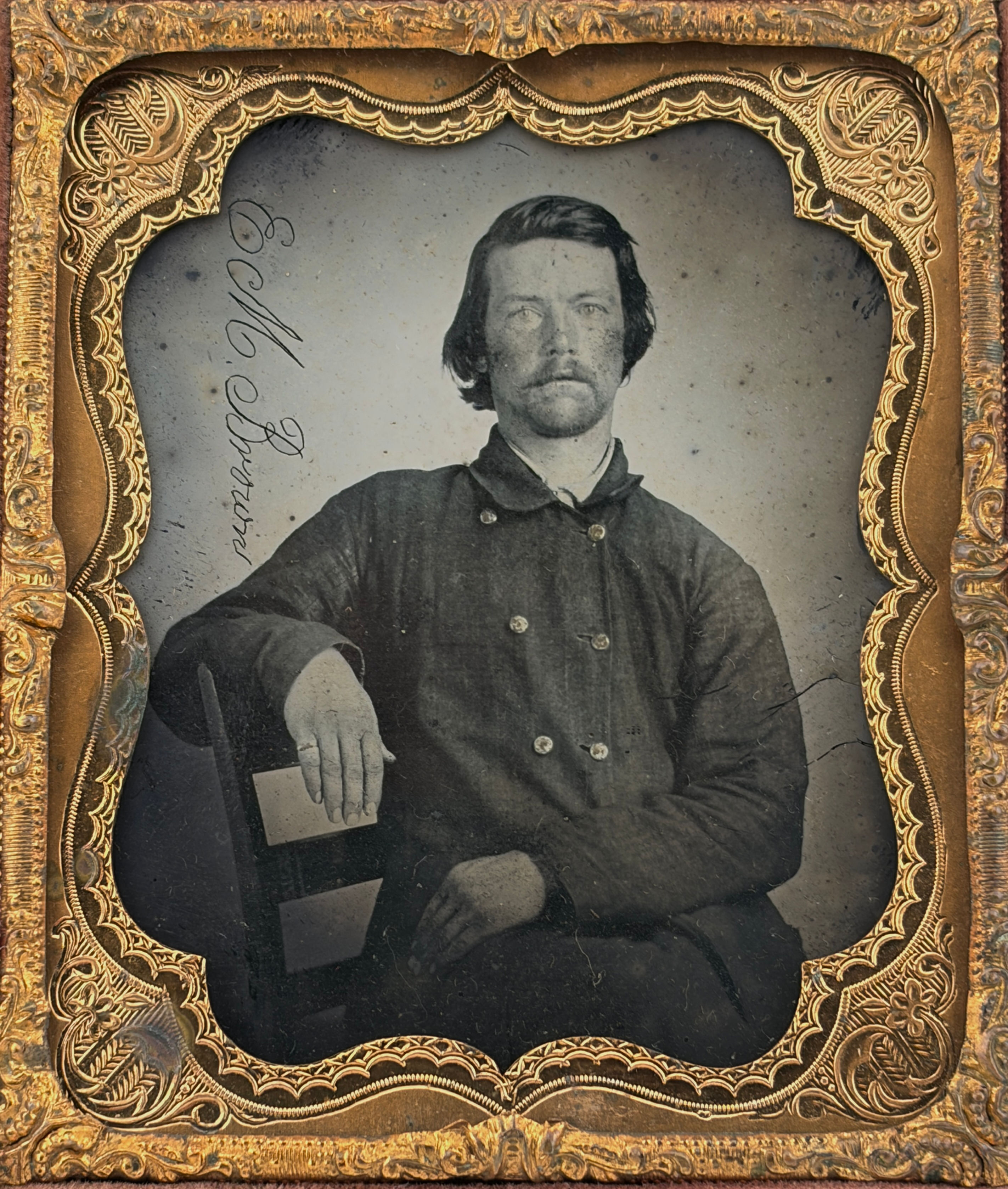

Identified 1/6th Plate Ambrotype of a Soldier in the 4th Tennessee Cavalry
Identified 1/6th Plate Ambrotype of a Soldier in the 4th Tennessee Cavalry (Murray's Regiment, Forrest's & Wharton's Brigade)
This exceptional 1/6th plate ambrotype depicts Private Edward M. Brown of the 4th Tennessee Cavalry (also known as Murray's Tennessee Cavalry Regiment). The image was discovered paired with another identified ambrotype of Campbell Craig, also of the 4th Tennessee Cavalry. Both portraits were featured in the March/April 2004 issue of Military Images magazine (Volume XXV, Number 5), in the article "3 Members of the 4th Tennessee Cavalry" by John Sickles.
In the photograph, Edward is seated and attired in a double-breasted frock coat, with a striking period inscription scratched into the emulsion. The ambrotype is preserved in a thermoplastic case.
Edward M. Brown enlisted on August 22, 1862, in Dixon Springs, Tennessee. His regiment, initially attached to General Nathan Bedford Forrest's Brigade, participated in the Kentucky Campaign (including the Battle of Perryville) before transferring to Colonel (later Brigadier General) John A. Wharton's Brigade. The unit saw action at the Battle of Murfreesboro (Stones River).
According to his Compiled Military Service Record, Edward was reported absent without leave as of January 5, 1863, and subsequently dropped from the rolls by the War Department. In Confederate practice, this administrative action—following prolonged unauthorized absence without further explanation—typically indicated desertion, especially amid widespread AWOL cases in early 1863 due to supply shortages, morale issues, and post-battle hardships. While possibilities such as capture or death in action cannot be entirely ruled out without additional records (e.g., POW rolls or casualty notations), no such entries appear in standard sources, making desertion the most probable explanation.
Regimental History
The 4th Tennessee Cavalry (Murray's) was organized in August 1862, incorporating Spiller's Tennessee Cavalry Battalion as its core. On September 14, 1862, it was assigned to General N. B. Forrest's Brigade. Following Forrest's detachment back to Tennessee by General Braxton Bragg on September 25, the regiment joined Colonel John A. Wharton's Brigade.
Contemporary dispatches from Wharton illustrate the unit's early movements:
- On September 26, near Bardstown, Kentucky, Wharton reported having seven companies of Colonel Murray's Regiment in camp.
- On September 27, at High Grove, Kentucky, he detailed three companies under Captain C. H. Ingles posted at Salt River along the Louisville and Bardstown Pike, and noted sending others toward Shepherdsville.
By November 25, 1862, Wharton's Brigade included the 3rd Confederate, 2nd Georgia, 4th Tennessee, Bledsoe's Battalion, 8th Texas, White's Artillery, and Captain Anderson's Cavalry Company. Some organizational confusion arose, as Bledsoe's Battalion was likely part of Murray's Regiment. Around this period—coinciding with Colonel Murray's election to the Confederate Congress—efforts were made to divide Murray's Regiment into separate commands. References in Lindsley's Annals date the organization of Baxter Smith's Regiment (officially the 8th but commonly called the 4th Tennessee Cavalry) to November 1, 1862, at Nolensville, Tennessee. On November 27, General Joseph Wheeler was authorized to expand Bledsoe's Battalion into a full regiment, though he reported on December 25 difficulties in securing companies for both Smith's and Murray's commands.
This transitional status is confirmed at the Battle of Murfreesboro (December 31, 1862–January 2, 1863), where Wharton's Brigade comprised elements including Murray's Tennessee Regiment (under Major W. S. Bledsoe). Wharton praised Bledsoe's service in destroying irremovable wagons and noted heavy losses in Murray's, Smith's, Cox's Regiments, and Malone's Battalion.
Attempts to form distinct regiments for Baxter Smith and Bledsoe ultimately failed. The 4th Tennessee Cavalry (Murray's) was officially disbanded on January 23, 1863, with its companies redistributed: four to Baxter Smith's Regiment (where Bledsoe became Major), others to the 22nd Tennessee Infantry Battalion and 1st Confederate Cavalry Regiment.
This ambrotype represents a rare, identified portrait from a short-lived but active Confederate cavalry unit during key 1862–1863 Western Theater operations.