

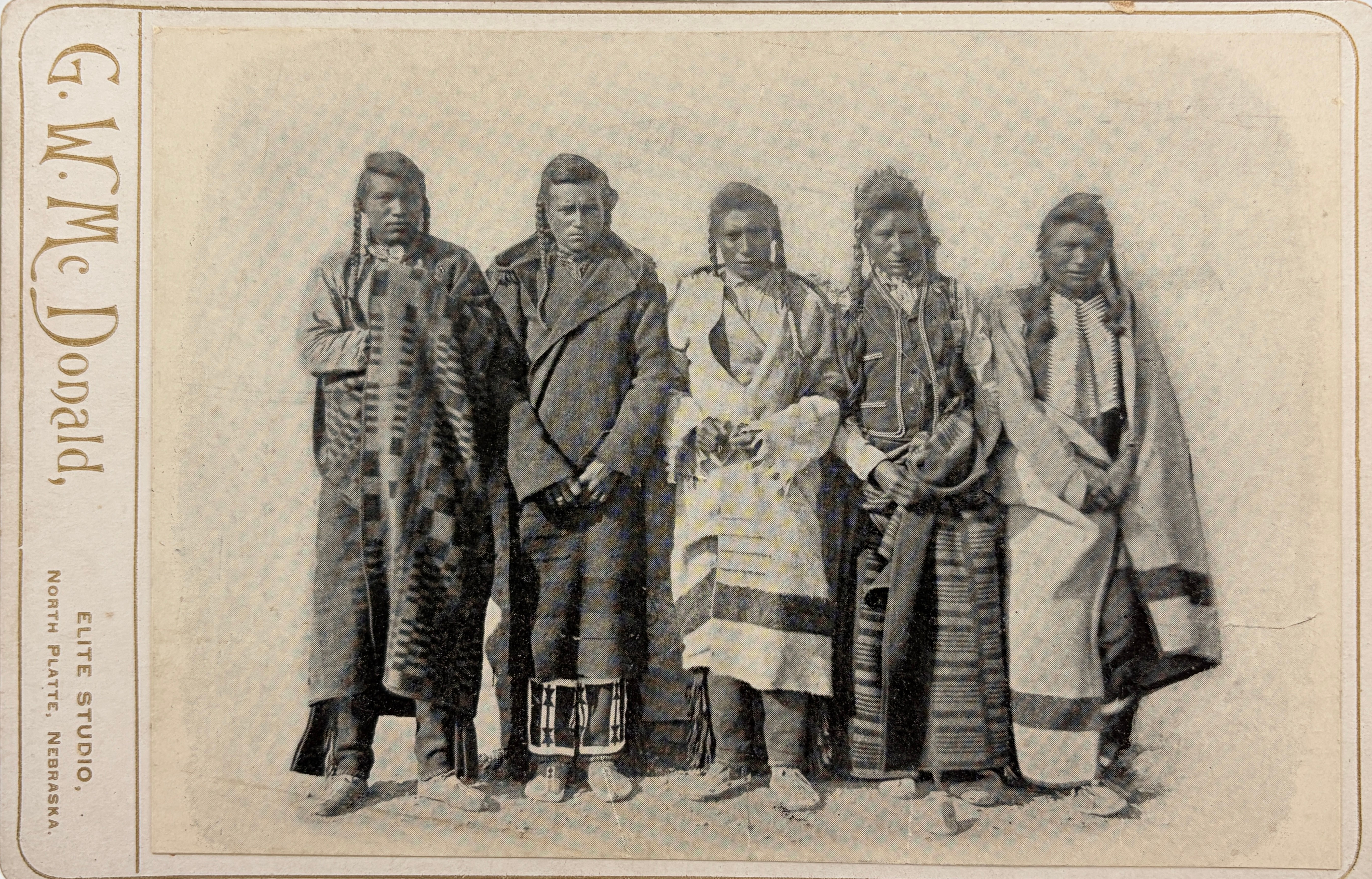
Cabinet Card of Native Assiniboine Men Taken by G. W. McDonald North Platte, NE
Cabinet Card Portrait of Five Assiniboine Men by G. W. McDonald, North Platte, Nebraska
This rare late-19th-century cabinet card (approximately 4¼" x 6½" mount) features a striking group portrait of five Assiniboine (Nakoda) men, captured in the studio of G. W. McDonald in North Platte, Nebraska. The photographer's imprint appears on the recto or verso, typical of frontier studios operating in the 1880s–1890s along rail lines and trade routes in the Great Plains region.
The subjects are posed formally—standing in traditional or transitional attire that reflects Plains Indian cultural elements of the era, such as blankets, beaded or quilled accessories, or Euro-American clothing adapted to reservation life. The Assiniboine, a Siouan-speaking people historically allied with the Sioux and known for their nomadic buffalo-hunting traditions in the northern Plains (spanning present-day Montana, Saskatchewan, and Alberta), were displaced and confined to reservations like Fort Peck and Fort Belknap by the late 19th century. Images like this often date to periods of travel, delegations, or interactions with settlers, railroads, and photographers in Nebraska towns like North Platte—a key Union Pacific hub where Native delegations sometimes passed through or posed for portraits.
G. W. McDonald (full name George Willis McDonald, 1862–1911) was a documented itinerant and studio photographer active in the American West, including locations in Colorado (e.g., Denver) and Nebraska. His work occasionally included Native American subjects, aligning with the era's demand for ethnographic portraits amid westward expansion and the decline of traditional lifeways.
Cabinet cards of Assiniboine groups from this period are scarce in private hands, with most surviving examples in institutional collections (e.g., Smithsonian's National Anthropological Archives or Nebraska State Historical Society holdings). Comparable Plains Indian group portraits from Nebraska studios command strong collector interest.
This card is a compelling artifact of 19th-century Plains Indian history—documenting dignity amid change—and a fine addition to collections of Native American photography, Great Plains ethnology, or Western frontier imagery. Condition appears solid (typical minor toning, edge wear, or mount soiling expected; strong detail and contrast).